News
Stay informed about our work to strengthen food security across Northern Arizona.
The Headlines Behind Hunger in Northern Arizona
Help Shape the 2026 Northern Arizona Food Policy Voter Guide
We are creating the 2026 Northern Arizona Food Policy Voter Guide—and we need your help.
From now until noon, Aug. 17, 2026, please take our survey and help us decide which question candidates should answer about hunger, food access, nutrition, or food security in Northern Arizona.
Your ideas will help ensure that the challenges facing our communities are part of the conversation during the 2026 midterm elections.
Consider these facts from our partners at the Flagstaff Family Food Center and from the Coconino County Health Needs Assessment:
Almost 1 in 3 children in Apache County are food insecure — one of the most severe rates in Arizona.
55% of food bank clients report at least one household member managing a diet-related health condition, including diabetes, hypertension, and high cholesterol.
Coconino County has a rate of 91.7 fast food restaurants per 100,000 people, which is higher than both Arizona and the United States.
Register to learn about 501(c)3 Advocacy
11 A.M. MST, Tues. July 28, 2026
Nonprofit VOTE + AZ Food Coalitions: 501(c)3s and Advocacy 101
NAHAP is excited to partner with the Arizona Food Systems Network (AZFSN) to offer this training from Nonprofit VOTE
Nonprofit VOTE is the leading provider of nonpartisan resources to help nonprofits integrate voter engagement into their ongoing activities and services.
At this one-hour training, you’ll learn which advocacy activities 501(c)3 organizations legally can and cannot do in election years. Join us and become better advocates for the issues that are important to you and your organization.
NOTE: Afterward, NAHAP members will select the two food policy questions we will ask candidates running in this 2026 election. Stay for an extra 30 minutes to be involved in this process!

Coalition Food Banks Serve During Arizona Wildfire
This month, we’re focusing on the tough situation in Sedona after the Pocket Fire scorched more than 25,000 acres and forced evacuations.
“When the fire first started we bought snacks and fresh fruit for the firefighters. Additionally, I visited with the Red Cross Evacuation Center to inquire about food assistance. I was told the Red Cross provides food from local restaurants. I connected them with local restaurants that are very supportive and community minded organizations,” said Cathleen Ann Healy-Baiza, executive director of the Sedona Community Food Bank.
“I have an increase of clients due to the fire. These new clients had jobs in the canyon but as of yet the canyon remains closed,” she said.

A New Chapter for NAHAP: Coalition Welcomes New Organizer
The Northern Arizona Hunger Action Partnership is pleased to welcome Michel Marizco as our new Coalition Organizer. Michel joins the partnership after a distinguished career in journalism, bringing extensive experience in community engagement, investigative reporting, and building connections across Northern Arizona.
“I’m both thrilled and humbled to be here; I’ve been struck by both the scale of the challenge and the dedication of the people working to meet it,” Marizco said. “The long lines of cars at the Flagstaff Family Food Center’s Food Box Distribution Center, the visible hunger of families at the Dinner Service, and the growing need across our communities make it clear that strong partnerships and coordinated infrastructure are more important than ever.”
NAHAP’s role as a coalition will help strengthen collaboration among nonprofit organizations, government agencies, community leaders, and other stakeholders working to improve food access throughout Northern Arizona.

Latest Farm Bill Version Rejects Calls to Delay Changes to SNAP Funding
The U.S. Senate’s version of the 2026 Farm Bill does not delay proposed changes to SNAP funding, according to recent reporting from Civil Eats.
Anti-hunger advocates across the country — including the Food Research & Action Center, Feeding America, and the National Sustainable Agriculture Coalition — have called for these changes to be delayed or removed altogether. The proposal would shift a greater share of SNAP costs to states, with each state’s responsibility determined by its SNAP payment error rate.
In Arizona, this could eventually mean more than $200 million annually in new state costs to operate SNAP. For anti-hunger partners, this raises serious concerns about state budget pressure, program access, and the long-term stability of food assistance for Arizona households.
Democratic lawmakers have said they will oppose the Farm Bill unless it includes a delay in shifting SNAP costs to states.

Sept 3: Northern AZ Anti-Hunger Summit
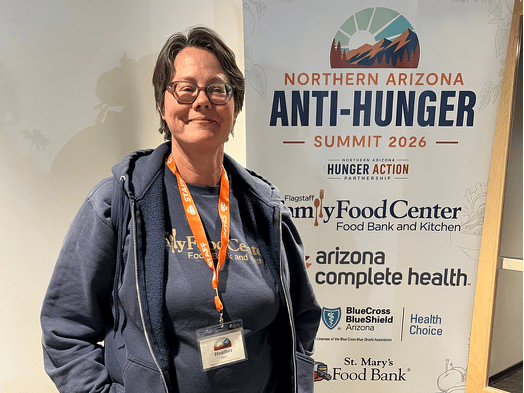
The 2026 Northern Arizona Anti-Hunger Summit, Feeding the Work: Sustaining Progress Amid Rising Hunger, Increased Resistance, and Collective Fatigue, will bring together community leaders, advocates, service providers, and cross-sector partners to strengthen our region’s collective response to hunger.